Implicit Regularization & Shortcut Learning
Mitigating spurious correlations by tuning optimization inductive biases.
In safety-critical domains like healthcare, biomedical data often contains complex, unknown, or hard-to-eliminate biases. When machine learning models train on this data, they frequently rely on “shortcuts”—spurious features that are strongly correlated with the target label in the training distribution but remain unstable across different environments.
Learning these shortcuts severely impedes the model’s ability to identify invariant, core features. As a result, a model might achieve high overall accuracy on average, but fail catastrophically on out-of-distribution or minority samples where the spurious correlation does not hold.
My PhD thesis focuses on modifying the inductive biases of models to prioritize robust, fair performance across all subpopulations. Specifically, I explore how optimization hyperparameters, like batch size and learning rate, govern a model’s reliance on these shortcuts.
The Optimizer’s Role: SGD vs. Gradient Descent
Gradient-based optimizers are often treated as black boxes that converge to a max-margin solution, but they play a fundamental role in what a model actually chooses to learn. Even when fully informative invariant features exist, models often favor spurious features because they artificially increase the margin, accelerating the reduction of empirical loss during optimization.
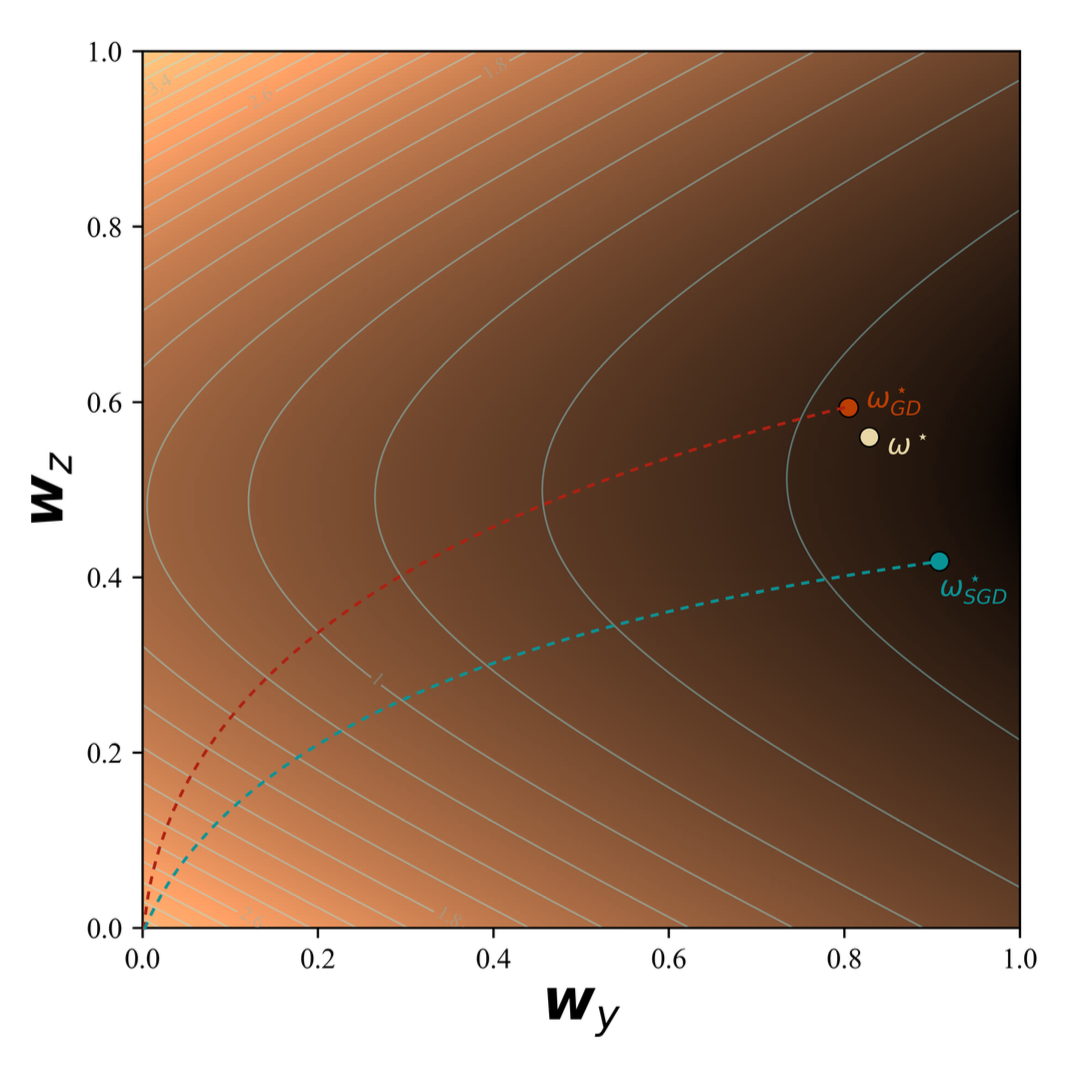
Our research uncovers a striking phenomenon: Stochastic Gradient Descent (SGD) systematically suppresses dependence on spurious features, while full-batch Gradient Descent (GD) does not confer this benefit and may actually exacerbate shortcut reliance.
This happens due to the implicit regularization inherent to the optimizers. While GD penalizes the squared norm of the full-batch gradient (favoring flatter minima), SGD additionally penalizes the variance of gradients across mini-batches.

The Power of Small Batch Sizes & Large Learning Rates
We established both theoretically (using a four-point data generation model) and empirically across deep neural networks that the robustness gains from SGD are directly tied to hyperparameters: the effect intensifies with smaller batch sizes and larger learning rates.

By viewing each mini-batch as a sampled “domain” from the training distribution, smaller batch sizes naturally increase the variability in subpopulation composition. Suppressing gradient variance under these highly fluctuating conditions forces the model to abandon shortcuts and rely on stable, invariant features, significantly improving Worst-Group Accuracy (WGA).
Furthermore, we found that training with small batch sizes provides a much stronger inductive bias when paired with explicit debiasing methods (like DFR, AFR, and EVaLS), yielding WGA improvements of 25-37% on complex datasets with multi-level spurious correlations.
This perspective reveals that robustness can emerge naturally from the inductive biases of standard optimizers, reducing the need for exhaustive hyperparameter searches in explicit shortcut-mitigation frameworks (Mirzaie et al., 2026).